Aguilar Blackjack System Review
Updated to include sims of the most difficult version (Aguilar II)
with further analysis.
The Aguilar System is a Blackjack card counting strategy aimed at single
deck play that can be found at www.sniperflashcards.com and advertised
on Google. The author, Victor Aguilar, asked me to review the strategy.
Although I made no agreement not to divulge particulars of the strategy;
I will not provide details here. But, I will share my results.
The website makes the claim that the three hands 16vT, 15vT and 14vT
are the key to single deck Blackjack. (After this review was written the
site was updated to include additional hands.) Further that the popular
counting strategies have poor correlation coefficients to these three
plays, unlike Aguilar. It continues that it is irresponsible of Stanford
Wong to publish a book “bristling with index numbers” without
mentioning the poor correlation coefficients obtained with the HiLo tags
for these plays. (I don’t agree.) At first the author requested that
I review the strategies and confirm the correlations. I told him I really
had no interest in looking at three specific plays as that has no meaning
but would be glad to review the overall efficacy of the system, at no
charge. He sent me the material.
Although I won’t talk about the details of the systems, I will say
that there are four levels of difficulty.
- Level 1 - The Basic system appears not to be positive EV. That’s
OK if people are so informed. (Unfortunately the material contains no
information at all on EV.) I did not sim it because it was in my opinion
too difficult for a Blackjack basic strategy.
- Level 2 - The second level I simmed for single deck H17 as this appears
to be the primary aim of this card counting strategy. The SCORE using
optimal betting was on average about 91% of the SCORE of HiLo with the
Illustrious 18. (SCORE is the accepted modern method of comparing Blackjack
strategies described in Don Schlesinger's Blackjack Attack.)
This is with a spread tuned to favor Aguilar over HiLo. Also, although
I used 18 indexes for HiLo, I used over three times as many indexes
for Aguilar. In my estimation, Aguilar Level 2 is somewhat more difficult
than HiLo at single deck. There are also double deck and shoe versions.
The shoe version is far more difficult than HiLo. In my opinion, it
is substantially more difficult than Hi-Opt I with an Ace side count
while not close to its SCORE. The poor results are not surprising considering
the very poor betting correlation and playing efficiency (BC and PE.)
- Level 3 - I did not bother to sim the next level since it is far too
difficult to use. More difficult than Hi-Opt II with multi-parameter
tables in my opinion. The strategy requires multiple balanced counts
applying them in different manners for different indexes. And yet it
has obvious playing errors.
- Level 4 - I do not believe the most advanced level is possible for
a human requiring that the player keep up to four counts (three of them
balanced) combined in nine different manners for different plays. Essentially
what the developer is attempting is to use specialized counts tuned
to each situation. Even with all this complication, simple plays like
Splitting twos and threes are omitted. However, I have now simmed Level
4 (named Aguilar II) out of curiosity. The sim follows:
Aguilar II Simulation
AgII is extremely complex not only in the fact that there are three balanced
counts for single deck but in how these counts are used. Depending on
your hands, you add or subtract different combinations of counts. As you
draw cards, the combination of counts used changes. In fact, I don't think
a human can master this strategy without significant errors even if he
brought it with him to the table and used pen and paper to keep the counts.
This also makes it very difficult to set up a simulation, particularly
as there is so little explanation. Every rule and every index was used
including depth sensitive rules and composition dependent rules. To ensure
that I was indeed setting it up correctly, I determined the reason behind
each rule to make certain the specifications made some sense. I also simmed
individual rules to ensure that I wasn't adding one rule incorrectly harming
the overall results. Finally, I examined every possible two card hand
against dealer upcard to make certain there were no setup errors. I ran
two billion rounds. Victor falsely claimed that I rigged the Level 2 sims
by restarting over and over with different random seeds looking for a
particular result. Anyone familiar with Monte Carlo techniques knows this
is not possible with two billion rounds. I am also releasing the detailed
sim results which would clearly show if the results were faked. Further,
I have absolutely no motive to bias results against the strategy. In fact,
I could profit from the strategy if it worked as claimed.
For comparison, I selected Hi-Opt I. HOI has available both an Ace side
count for betting and multi-parameter tables. However, I used no side
counting at all with HOI. Without side counting, I have in the past rated
HOI the easiest, viable, true-counted strategy ever developed. Sims were
single-deck, H17, nDAS, DOA, Resplit. These appear to be the rules aimed
at. I used the same number of indexes for HOI and AGII. The indexes selected
for HOI were somewhat different as they are tuned to the count. I used
Braun's indexes from WGBJB. The AGII strategy has no instuctions on betting
at all. The site indicates that it was designed for flat-betting. I tried
flat-betting first and had a tiny positive EV. But the SCORE was below
1 and the N0 about 1,300,000 hands. That means a $1 an hour win rate with
a $10,000 bankroll and is clearly not usable. So I used a spread of 2.
This is still low, but I wanted to bend over backwards to be fair to AGII.
Three players were simmed with our player at third base. Three rounds
were dealt per shuffle. (Out of 2,000,000,000 rounds the dealer ran out
of cards 30 times.) No dealer or player errors were simmed.
Results
Results are stated in c-SCOREs as described in Don Schlesinger's Blackjack
Attack. Results:
|
|
SCORE
|
N0
|
|
Hi-Opt I
|
26.20
|
38,165
|
|
Aguilar II
|
17.29
|
57,825
|
Aguilar II, a level III strategy with three balanced counts has a lower
win rate than Hi-Opt I, a level I count with no side counts.
Why?
So why is one of the easiest true count strategies substantially more
powerful than the most difficult I've ever seen? First we need to understand
that just because a strategy has a good Playing Efficiency does not mean
that it will automatically perform well. This is why such stats as PE
and BC are useful in developing strategies; but should never be used in
evaluating a strategy or comparing the overall strength of strategies.
An evaluation must take into account every detail of a strategy as it
is played in a casino. Unfortunately, simulation is the sole method of
accomplishing this task. The good news is that simulation can also tell
us the weak points of a strategy.
To examine the strategy in more detail I used three features of CVData.
The first is the Hands Win Rate table. This table tells us the win rate
per hour for every combination of player first two cards and dealer up
card. The second is the SimTract function. This subtracts all of the 60,000
stats in one sim from another sim. The third is CVChart which allows custom
chart construction. The result is the below chart that tells us the difference
in win rates between Hi-Opt I and Aguilar II for each possible hand.
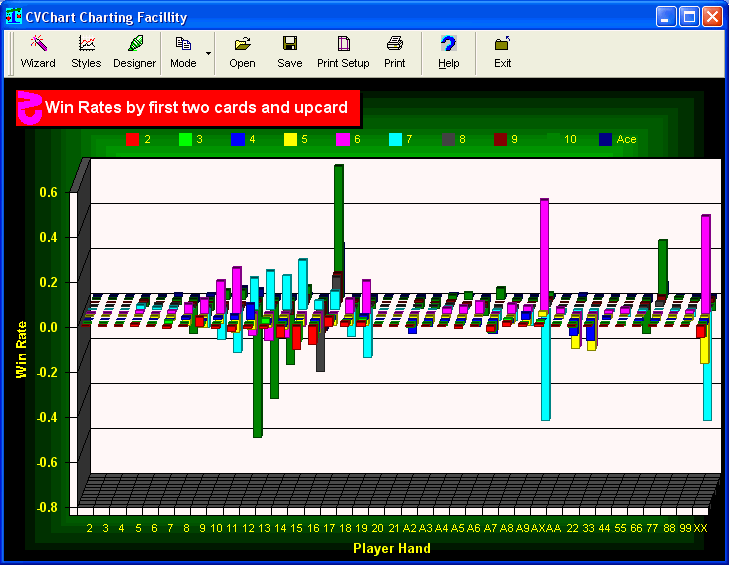
Note: It is a bit difficult to use a static image of this chart (CVData
allows you to rotate it in three dimensions with the mouse) but bear with
me. When you see a bar move upward, that means AGII is performing better
for that hand. When the bar points downward, HOI is performing better.
You will note several pink and cyan bars that appear to balance each other.
For example, A,Tv6 shows far more profit for AGII but A,Tv7 show far more
profit for HOI. This is because the betting counts handle the six and
seven differently for the two strategies. These points balance each other
out and can be ignored for this study. However, there are some points
that are very meaningful:
- 12vTen, 13vTen and 14vTen are big losers for AGII. These are the three
downward pointing dark green bars. Looking at the instructions, I see
that AGII handles these three plays in an unusual manner. Two use only
the AGII side count and the other uses the sum of three counts. I fired
up CVIndex and found the problem. The indexes in the documentation are
way off. Two of them are off by 5 points causing far too many busts.
Normally indexes are not all that sensitive. But in single deck, against
a Ten, an index off by 5 can make a large difference.
- There are blue, yellow and red bars pointing downwards for hands 2,2
and 3,3. That one is easy. These are the 22 and 33 Splits. Aguilar has
no Splits for twos and threes making it a poor performer for these hands.
- There is a dark colored bar pointing downward for hand 16v8. This
means that AGII is not handling 16v8 correctly. I generated the index
and found that the index was off by 4. This is a substantial error.
- You can't see this from this chart, but the betting correlation is
also very poor using AGII. At a 1-2 spread this doesn't make a huge
difference, but has some impact. This can be fixed to some degree by
using the sum of the AGII primary and Ace, Six side counts for betting.
However, since none of the three Aguilar counts count Deuces, a very
good betting correlation cannot be achieved.
So, for the fun of it I ran AGII again but with the above fixes. The
SCORE climbed from 17.29 to 27.25, slightly edging out Hi-Opt I. With
these fixes, the level I Hi-Opt I with no side counts is slightly bested
by AGII, a level III strategy with three balanced counts. Now I only looked
at a few indexes and they were significantly incorrect. It is quite probable
that a full set of correctly generated indexes would make a further difference.
But even with a full set of correct indexes, I do not think it makes any
sense for a Level III strategy with three balanced counts to ignore Deuces.
Detailed Results
Detailed results of the Aguilar II sim can be found at Sim
Results.
Conclusion
Unfortunately I don't think these strategies add to the viable methods
of beating Blackjack. The general trend in strategies over the last decades
has been greater simplicity. That does not mean there is no place for
more difficult strategies. But, the gain in advantage must be worth the
extra effort. I would also like to say that when beginning to work out
a new strategy, it is valuable to look at selected aspects of the theory
of Blackjack and how they can be maximized. That is, looking at the most
common hands can be of value in the early stages of card counting strategy
development. But, in the later stages of strategy development, only long
term goals are of importance.
|